
The Meditation and the Meaning
A love story about the Bible, losing it and finding it, and an invitation for your ideas.
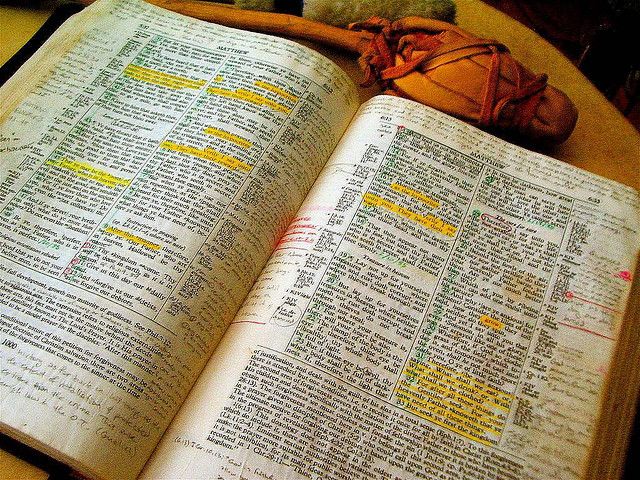
Many of you who read thirtysixwords, grew up as I did: Sunday morning and evening, butt-in-seat, hard pew, pinned between mom and dad with a ziplock of Cheerios if you were good. I never knew a Bible that didn’t have highlights and notes in all the margins. Our Bibles were never mantlepieces, they were scuffed, bent pages, bulletins from three years ago still stuffed in the covers.
In this climate, I learned to love the Bible. I found fascination in its stories, unexpected insights all the superscript-noted connections between one book and the next. The Bible was the ultimate puzzle, a vast web of possibilities to explore. Quiet times, sure. Memorization, fine. But what awakened me was the hunt and the unsupported hunch that there was more here than meets the eye.
What I always loved about the Bible was the chase, the trip down the rabbit hole of possible meanings and historical connections, deep timeless realities trapped in millennia-old histories. My love for it blossomed in college when I was taught the inductive method—a way to explore on my own, let the text breathe, and not demand from it immediate application to my life.
What Does it Mean to You?
While college gave me the power tools of inductive study, it was also my introduction to the “small group Bible study,” a concept completely foreign from my Sunday-School driven Baptist background. I gritted my teeth sitting in a college dorm room as we would read a passage, go around the circle, and--with no rhyme or reason--twist the stories into self-affirming meditations on indecipherable platitudes.
“The passage makes me feel like God really loves us.”
“That verse reminds me that we are very sinful and it’s good that God is in control.”
“God’s timing is perfect.”
I never really understood what these global sayings meant, much less how you could pull them out of the passage. As an adult, trekking my way through bonafide and would-be megachurches, I found that this way of feeling ourselves through the Bible was not the outlier but the norm. Sermons were not the things I had grown up with. They were personal meditations on life experiences, punctuated with verses to establish Christian cultural relevance.
By this point, I was a seminary graduate (a dangerous thing, for sure). I now understood that these theological sayings like “God’s timing is perfect,” were self-help versions of a particular stream of Christian theology. Certainly not it’s whole, but definitely the brand that was quickly subsuming American faith. This brand had more similarity to America’s pursuit of happiness than it did the complexities of a 1st-century Jewish teacher and resurrected martyr. My education in its reach and its inflexibility was the beginning of my essential break with the church as it is so commonly dispensed.
The Bible After Evangelicalism
Today, I would give my left arm for one of those inductive studies from college. The kind marked by comments like—
“I didn’t know it said that!”
“They always leave that out of the sermons!”
“How could I have missed this all my life!”
and a personal favorite:
“This God is more difficult than the one I thought I had, but this God is so much better.”
I led a group in these kinds of studies for years when we lived in Denver. And those Sunday nights were some of the richest of my adult life. (Hello, Tribe readers!)
Sometimes when people ask me when I knew I couldn’t contribute to the American evangelical fervor anymore. One of my many answers (there are a dozen strands to this cord) is, “when I realized that mainstream evangelicalism doesn’t love the Bible.”
They understand its usefulness for proof-texting—lining up arguments against one’s theological enemies—but there are so few signs of love. No curious flirtation with its hidden meanings, no stunned silence when it reflects back to us something we don’t want to see. Two centuries of literalism have made the text a standard-bearer for indefensible ideas about nature, gender relations, and politics. These same tactics stripping it of its power and meaning.
To love the Bible is to be continuously bowled over by it. Shocked by how much deeper it goes—intimidated by its beauty. To love it is know it’s not God and cannot contain God. To love it is find God not in the text but behind it, around it and in front of it, lurking in plain sight.
When we study the Bible with surrendered curiosity, we find ourselves pressed between the Spirit within drawing us in, and the God behind the story, drawing us out. This is the work of meditation and meaning. Of exploration and wisdom.
The Best Kind of Romance
I have never opened up a text without a twinge of fear in my heart. I know from all these years that I will find something that presses me, something that exposes me, something that imagines and images a God that my current God-box cannot contain.
The Bible and I have never left our Honeymoon period; I am as I was then: enamored and curious, wondering what glorious strangeness will reveal itself this time. As I have matured in my search (but in no way am I “mature”), each trip into the text is both a search for meditation and meaning.
As a mediation, I want to marinate in the words, feel the strange juxtapositions, act ever so slowly, willfully dropping my preconceived notions of what I am going to find. When I sink into the words as a work of art I am never expecting to find “the meaning” or even the “meaning to me,” I am not looking into Scripture, I am praying that the Scripture looks into me. Like gazing into the eyes of an old friend or lover, you are both safe and undone. Held and revealed.
As a hunt for meaning, I want to be informed by the original languages and culture, thoughtful research and history, resting in the truth that the text is not endlessly elastic. It’s meanings “for me” must rest consistently with its implications for them (the original readers) and for all (people who don’t share my social, economic, or historical location).
Perhaps its time to wrangle some folks and dive back in, start a new study group. Maybe I should use this space to write more about the stories of Jesus and Israel. If you have ideas, I would love to hear them.
But this much I know, my life has been spent chasing the wormhole of mystery. And the Bible has been my most useful companion on that journey.
Let’s go.