
Last Time, This Time, & the Next
A new year make us think about time. But for Christians, the freedom is in knowing it's all the same time as last time.

When I restarted this little writing exercise under the banner of Thirty-Six Words, I convinced myself to avoid all wax-philosophical impulses. New Years makes that a Spartan Race of an effort. The fresh snow of a fresh year consistently draws me into questions about the past, the present, and the impending future that breaks on our horizons and backs every January 1. So we’re in for a little deeper dive today than normal, but bear with me because there’s gold in them-there hills.
(insert obligatory “unprecendented times” paragraph)
(Because on average, last year was total shit, theologically speaking,) the trip from ‘20 to ‘21 is uniquely fraught with attempts at instantateous tranformations. But 2021 didn’t invent the quick turnabout. Growing up as I did deep in evangelicaland, the merger between the Bible’s view of maturation and America’s view of prosperity were intrinsically linked. Transformations ought to be fast, productive, self-made, and—if possible—lucrative. God helps those who help themselves. Pass the clicker, dear, Paul and Jan Crouch are on.
We all know that this way of getting better year-over-year doesn’t work for us. But our idealized views of others, fueled by our consuption of their social media selves, lead us to believe that we are the outlier. Surely self-help serenedes work for some people. It’s me that’s the problem. This year will be different. You’ll see.
Our view of change, particularly our own, gets mapped on to a linear timeline. One that is expected to go up and to the right, as smoothly as possible. We treat our own journeys like the stark market, demanding high returns, low volatility.
The Shame Way Through
One of my favorite movies is Disney’s Hercules. It has the best music of any of the golden era of animation, and among the best villains. As far as villain sidekicks go, Hades’ defunct demon duo, Pain and Panic, notoriously cry out, “We are worms!” transforming into their likeness at first hit of Lord Hades’ criticism. They know that the best way to appease their particular god, is to embrace the shame way through.
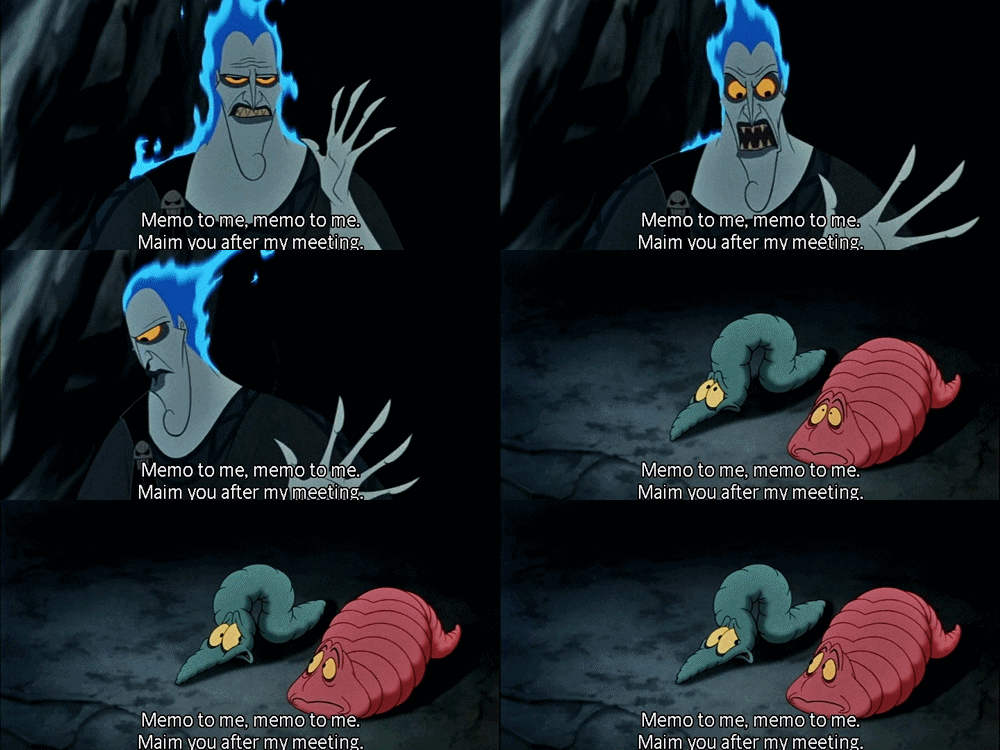
Many of us learned a form of Christianity where Lord Jesus is not dissimilar from Hades, Lord of the Dead. Those of us caught up in the Piperstream of the 90s and early 2000s (If you’re formally unfamiliar with John Piper and his form of neo-Calvinism, be at peace, dear friend.), learned that self-improvement was not what Christianity was for. Humans were too deprave for all that.
If prosperity gospel and its evangelical step children promised a name-it-and-claim-it form of personal growth, the other end of the AmEv (American Evangelical) pool offered it’s inverse: there’s nothing we can do to alter ourselves. If we suck, it is God’s will so that we see just how non-sucky He can be.
This spawned some pretty rockin’ worship tunes, but also some pretty tragically shattered hearts. Some folks are still struggling whether that was a good trade. I, if you haven’t caught on, am not.
The shame way through, where self-hatred is the fast track to worship, seemed the high road to me for many years. That is, until the consequences therein over-ran me and nearly tore my spirit in two.
Enter the Gospel
I was a Christian for almost 30 years before I started to really see how much my love for Jesus had been tainted these darker, notably non-Christian trends. I had been trained by theological biases that sent me to the Bible looking for validation for my shame, quick escape from my shame, and the acceleration of that cycle. I, of course, didn’t know that’s what I was looking for, but it’s like once you buy a Hyundai Sonata, you see them everywhere.
And then the freedom was in a question: Do I really want to drive a Hyundai Sonata?
Do I really want to follow a faith that reinforces and |*spoiler alert*| depends on my cycle of shame?
And the question after that: Is that actually the faith Jesus embodied?
And the question my life couldn’t allow me to escape: What does the Bible have to say about it?
Turns out, a whole lot. Much of which can’t be categorized here, but is the heart of everything I write. But one critical corner of that gorgeous sprawling meditative maze has everything to do with New Years, and the master of Jesus’ timeless time: The gospel writer, John.
Time Upon Time
John’s Gospel represents a second pass on the message of Jesus’ life, a reframing, three decades after the shared chronology of the events was laid out in Matthew, Mark and Luke. Those gospels, riffs on a similar set of sources, try to get the story straight for particular audiences. Never attempting journalism—no such thing exists in the first century—rather doing the best storytelling they can for awareness of the risen Jesus to become clear.
John speaks to an audience familiar with the story, second-hand recipients of it, and offers them the celestial view. He takes us beyond time, reording events, and showing us that how things happen… (this, then this, followed by this, caused by that, leading to the other) is a function of the broken world, what he refers to as “this aeon” or Age. Our wholeness does not live further down the line. It lives in a different Age all together, one that’s breaking in.
He contrasts the current Age and all of its consequences with the Age that is Coming, or the Age from Above. This Coming Age is not sequential, bound by history and the actions of human events. The Age to come is inbreaking, ever-present to those that are living in Christ. The concept of a sprawling eternity is hard to find in the original languages. Instead, there is a fullness of time, a reality where all the potential good is actual. Everything that could be beautiful is actually present.
The English translators loved to make this into “eternity” (another long line of time), when really it something close to the perfect moment. Where all the potential good is present to us in one unencumbered awareness.
We don’t have time here to talk about how this idea of the Coming Age has been masacred into the idea that we live for a while in the mess and muck, with the cross of Jesus acting as the ultimate portkey, rushing us to the Quidditch game in the sky.
What we must find time for is to realize what John’s Gospel actually suggests for us, this time. Or this Time.
For followers of the Jesus Way, we aren’t going anywhere. Because the fullness of time is present to us now. We have the option to embody it, express it, release it, surrender to it. We have the eternal option to be fountains of living water. Timeless water.
A coming year is not here to reform the past things. A new year is here to do the same thing last year did. And the year before that. And the year before that. Not improve us. Or shame us. (Which are two sides of the same coin.) Rather, to open us. Unclench us. Awaken us. To the eternal now. To the Age from Above, breaking in wherever we will allow it. It does not come to us via progress but by emptiness. Not by achievement but by surrender.
Because the presence of Jesus is always present, always here and never “there,” we are eternally free, NOW.
Free to weep. For we are comforted.
Free to hunger. For we are filled.
Free to forgive. For we are forgiven.
Free to love, because we are standing in the fullness of love. Now. Today.
I promised you and myself to not wax philosophical and it’s clear I failed. And I’d like to tell you it will be better “next time,” but of course, that’s the exact opposite of everything I just wrote.
Let me just say this instead: We aren’t headed anywhere, and we aren’t responsible for getting there. Our job, our only job, is to see that Light that is already here. To have our individual cracks reflect and refract it with technicolor brilliance. To live as if there is no tomorrow. Because quite technically, there’s not.
Remember that sharing is caring. 😊 If you’re here for the first time, subscribing is caring, too. 🤗